Saturday, December 10, 2011

Part IV: the thing itself


I woke at 4:30 the next morning, in order to be at Machu Picchu at sunrise. There were a few other hikers like myself along the twenty-minute road to the base of the mountain, bouncing along in semi-darkness. At the base of the mountain, you prove you have a ticket, cross the river, and then begin climbing. As you go up, you cross a number of switch-backs, with tourist buses lumbering along them. They'll beat you to the top, get in front of you in line, but they will not have the essential pilgrim experience of hiking straight up for an hour and a half. You can see in this picture all the switchbacks leading up to Machu Picchu. Buried in there somewhere is a hiking trail that goes straight up.

There are more pictures of Machu Picchu on my facebook page, and I think that's open to anyone, even if not members of the facebook community. But these are some of my favorite...

Thanks for reading! See you on the road to Lake Titicaca!


The Machu Picchu trip, part III

Just think, part three, and only the first day of the trek! How exciting for you, the reader!

Quick recap: First was the brutal bus trip to Santa Rosa, then an unintentionally meandering trek to Santa Teresa, which I am still on as the story unfolds. If I do make it to Santa Teresa, I will overnight there, then walk the next day to Aguas Calientes, and the next to Machu Picchu.


After leaving the insect killer, the trail was mercifully level for the next hour. I found what I think is the Perez Hacienda by following ducks - so far ducks and barking dogs presaged every human outpost. This place was no exception - ducks, dogs and cats lolled in various shady locations, but no Perezes or any other humans were in evidence. I wandered through the rather extensive compound, peering into windows and open doorways as I passed, but there was absolutely no one about.


No big deal, I guess, but I would have liked to confirm that this was indeed the Perez Hacienda. And maybe get another hand-drawn map for the collection...

At the Perez boundary, there were three clearly-marked trails. I had guessed wrong on about 50% of my trail guesses so far, and it would be dark in a few hours. I had no idea how far Santa Teresa was, and I had last seen a human about an hour ago.

According to my Argentinian friend back in Cusco, the trek from Santa Rosa to Santa Teresa took only two or three hours. I had been at it for more than five hours. Of course, the bus trip was only supposed to be three hours, and cost 15 sols. In reality, it was five hours and 30 sols. I had my doubts about the Argentinian...

Later, when I arrived back in Cusco, I talked with my landlord about the Argentinian. He related that they have a saying in Peru and no doubt in other Latin countries as well: If someone is loud, brash, and has no idea what he is talking about and speaks English, he is an American. If the person is speaking Spanish, he is an Argentinian. (No offense, he said to the American. It's just a story. Uh-hunh, I said, loudly and brashly...)

The left path went down steeply, the right went up steeply, so I picked the middle path. After about four hours of walking uphill, I had become a big fan of level ground.

The unnerving thing is to be on a trail, find a clearing, and see off in the distance, on a different mountain, another trail, actually populated by hikers.
Whereas on the trails I had chosen so far, there had not been a single other hiker. Uncanny that...

A bit distraught that I should need to get off my mountain and traipse up that other mountain in the distance, I trudged on. Screw those other people. I'm sure they're lost. That group with the guide.

Well, as it turns out, there're more than one way to skin a cat (sorry Midnight, Elmo, Sammy, George, Tica, et al). The trail I chose, the very Buddhist middle way, turned out to take me to a real road, well, a dirt road, but a road nonetheless, and within a kilometer, a weather-beaten sign that said "Santa Teresa 3". It was already 6:30, the sun had already hid his face behind the mountains, and I was overjoyed to find that I could rest my weary bones in three kilometers. I just hoped that a zero or a five hadn't fallen off the end of the sign...

As I stood there gazing stupidly at the sign, a family in a station wagon - different family - stopped and asked if I wanted a ride. So I got a little bonus, a little rest, and in minutes I was in Santa Teresa, a medium-size village surrounded by hills and mountains.

I found a hotel, asked for a quiet room, and was given one that looked out on the local high school futbol field, where band practice was currently underway. I'm not sure what "tranquilo" means in the local dialect; one can assume it means "loud as hell". But anyway I was dog-tired and slept through the evening's band practice - at least it wasn't an inventory of any kind, as far as I could tell.

Thankfully, the hotel's rules and regulations were spelled out in this sign.
I had to quell my urge to throw the door and fasten the television for sleeping.

The next morning, I awoke to early-morning band practice. It turns out there was an important parade this coming Saturday, and all the local children were in training to make this the noisiest parade ever!

Day two, I'm sorry to report, was spectacularly uneventful.

I walked along a road, then along a railway. The road and the rail tracks at times followed a river. As I got closer to Aguas Calientes, I passed mountains on my right, one of which housed Machu Picchu. This one has the flag of Cusco atop.

The hike from Santa Teresa to Aguas Calientes took about four hours. (Two if you're from Argentina.) It was pleasantly flat, and peopled, and direct, and there was a lot of vegetation. A pleasant stroll.


Thursday, December 8, 2011

Part II: Another Inca Trail

The Machu Picchu trail so far: I had been subjected to five hours of shouted inventories in the guise of indigenous song. I ate with the flies in a sleepy little shithole. I had been stuffed in the back of a station wagon with the watermelons and cumquats. Then I was released, and left by the side of the road...

I pulled out my notebook and tried to reproduce the map the driver had drawn on the back window. This was the first of several hand-drawn maps I used that day. In terms of utility, they ranged from utterly useless to incredibly misleading.

This was about 2 in the afternoon. I had started the day at 5:40 that morning, and it had taken every wool garment I owned just to make it to a taxistand. We had dropped some several thousand meters in altitude and now I had a ton of wool in my ever-heavying backpack, and I was sweltering in the mid-day sun.

I took the road less traveled, as it was the only option that made sense at that point. About a half-hour down that dusty road, a sign appeared pointing up a nearby mountain. "Inca Trail" it said. I knew it wasn't The Inca Trail, but at least it was an Inca trail. Close enough!

This particular Inca trail went more or less straight up, a slender path through mesquite, cactus, and about a hundred kinds of plant and tree that I couldn't recognize. About 40 minutes into the hike, I stumbled upon an adobe house, guarded by ducks, chickens and cats in equal measure. Grateful for the break, I sat on a bench outside the abode and talked to the ducks around my feet. Maybe they knew whether this was the right trail or not. The proprietress, a smiling old woman, came out of the house, supplied me with a Coca-cola and then laughed at my map.

She took pen to paper and drew an entirely different map, and she wrote "Casa de Monos" (monkey house) and "Perez hacienda" (Perez family ranch) at different junctures on the map. I was to follow the monkey, then find the ranch. I gathered that if I was faithful in my quest, the town of Santa Teresa would be revealed to me.

She pointed up the hill, and I was off on my search for a monkey house. I was wearing my Indiana Jones hat, I just wished I had the whip, too...

Within the hour, still ascending, sweating furiously, I stumbled on two houses set in the hillside, one slightly above the other. Ducks and chickens again, then a very old man sitting in front of the first house, who responded to my inquiries about monkeys by pointing me up toward the other house.


Indeed, there was a monkey sitting in a tree - actually attached to the tree - in front of the second house. I had found Casa de Mono"! A nice couple with a cute little boy ran this household, and they offered me sustenance and rest. I bragged to Lorenzo and Maria that I had made it up the steep hill without too much trouble - a lot of sweat, but no problem, pretty good for a 52-year-old. They thought that was nice, and had I by any chance run into Lorenzo's father at the other house? Who is 103 years old? And who could kick your lily-white American ass?

Well, that last part was implied, but I have no doubt he could...

Lorenzo looked at the maps I was carrying and after a good chuckle, drew me a new one, more of a topographical map. I saw that by his reckoning I was more than half-way up the trail, thank god, and upon reaching the top part, was going to go down, then across, then up some more, then way down, and I would find the road to Santa Teresa. Given the length of this new map, I began to worry about getting to Santa Teresa before dark.


Equipped now with three hand-drawn maps, each one supposedly better than the other, I departed - but not before taking a picture of these cutie pies, also members of Casa de Mono...
What the hell are they?

Well, up and down I went, seeking the Perez Hacienda and further validation that I was on the right trail. Then, I lost the trail. It was there, then it wasn't there. I backtracked down a very steep patch but couldn't figure out how to move forward. Then I saw a house in the distance, and made my way toward it, thinking it was the Perez Hacienda. I had seen no other evidence of human life since leaving the monkey house close to an hour ago.

The house was dilapidated, partly unfinished, maybe abandoned. Not much of a hacienda. As I studied the ruins, I heard a dog barking far off, and getting closer. I yelled "Ayudame!" (Help me!) and "Perdido!" (I'm lost!), hoping the dog understood Spanish, or he may have a master handy.

Sure enough, emerging from the thicket came a man, completely covered - gloves, hat, mask, and carrying a steel can, trailing this toxic bug-killing smoke. He asked if I had not yet gotten stung? At that exact moment, I felt this incredible pain in my shoulder, and I writhed in pain. He immediately doused me in the smoke, suggesting that I not breathe for a minute. He checked the sting location, and said I was lucky that the stinger was not lodged in my shoulder, as they were difficult to remove. I asked what kind of bug bit me, a bee, or what? But the name he gave was not bee or wasp (abeja or avispa) so I have no idea what the thing was. I asked if I was in trouble health-wise, and he said no. He said some people felt that this sting actually was good for your arthritis. Did I have arthritis, by any chance?

The insect-killer walked me to the proper trail, pointing out that I should stay on this two-foot-wide trail, and stay off that two-foot-wide trail. Easy as pie, no matter that they were completely indistinguishable, and that they crossed at times. He said he wasn't sure of the Perez Hacienda, not having been there himself. He said he kept to himself. You keep to yourself, do you? I thought, as I looked around me - no other person, road, house, or building of any kind for as far as the eye could see...

Buena suerte! (good luck!) he said, waving his smoking can. You're going to need it, he implied...

Stay tuned for Part III, the near-conclusion of Does Doug Even Make it to Machu Picchu, or Is He Eaten by a Puma?

Wednesday, November 30, 2011

Machu Picchu in three days or less. Part I


My Favorite Inventories

Everyone will tell you the only authentic way to get to Machu Picchu is by the Inca Trail, a grueling four-day trek over Andean mountains and through verdant jungles, guaranteed to make your nose bleed, your knees ache, and, eventually, your pride swell.

Unfortunately, you have to make a reservation some four to six months in advance, as access to the Inca Trail is limited to something like 2000 people per day. Otherwise, in high season, you'd be standing in line all the way from Cusco to Machu Picchu, and it would take far more than four days.


Well, this reporter is not capable of purchasing a ticket to an event in another country six months later: as it is, I have little knowledge as to where I'm going to be later today.

There are, for slackers like me, a few "second best" ways to get there, including the Salkantay Trail, rated as more difficult than the Inca Trail, or the Inca Jungle Trek, or a combination of mountain biking and hiking, or bus and hike, or taking the train and the bus, eliminating hiking altogether. (Actually, if you wanted to go via skateboard and kite-surfing, a travel agent in Cusco will no doubt arrange that for you.)

According to a friendly Argentinian fellow at my hostel, who became my adviser in all things adventurous, the only way to go was a three-hour mini-bus ride would take me to a little village named Santa Rosa, from which I could hike two or three hours to Santa Teresa, overnight there, then a pleasant two or three hours to Aguas Calientes, the staging area for Machu Picchu, which I could tackle the following day. This route, promised the Argentine, would be inexpensive, easy, and completely independent. This sounded like as good a plan as any.

But first, the minivan: I had to be at the bus station by 6 am, and hustled to get into place in time. Of course, I had forgotten the golden rule of all parts south of the US border: for god's sake, don't hurry! We spent the first 45 minutes of the journey stuffed in the unmoving van, waiting for enough people to want to go to Santa Rosa that day. I thought that since there were already more people than seats, we were adequately filled. I was wrong...


Once we got going, the driver tried to make up time by driving as fast as humanly possible. He made sure the route was cleared for him by honking almost constantly throughout the five-hour trip. I guess his theory was that everyone on the road - other cars, bicycles, pedestrians, cows and alpacas, etc. - would be able to gauge the distance and speed by counting the honks. And get the fuck out of the way...

In order to make the ride more pleasant for the 15 people in the 9-passenger van, the driver blasted his favorite CD on the speakers. And I mean blasted. I dug out my earplugs, which reduced the volume down to 100 decibels or so. The chosen music was of a variety of indigenous music that consists of a three-beat rhythm, a female singer shouting her ass off, and a sort of list. The first song, the shouted lyrics included: "Lima!", "Cusco", "Arequipa!", "Bagua!" and on and on, the names of cities and towns in Peru. Somewhat enlightening, I guess, if you were studying for a local geography test.

The next song, three beats, shouting "Peru!", "Argentina!", "Bolivia!", "Panama!", "Ecuador!", and so on. Again, if there was a test coming, we'd all be ready.

The next song, I swear, three beats, and it was "Cuba libre!", "Pisco Sour!", "Tequila sunrise!", "Martini on the Rocks!" and on and on and on.

I kid you not: shouted inventories in three-beat stanzas for five hours. Even when we took a break on the side of the road, the driver was kind enough to leave the engine running and the music blasting, so that we didn't miss a list.

This helped us take our minds a bit off the furiously fast, reckless driving, on the curvy wet cliffside roads. As a further diversion, I talked the guys in my row to bet on when the woman in front of us, obviously road-sick, was going to begin vomiting. I had "within the hour", the guy to my right had "one to two hours", and the guy to my left had "two plus". (Careening off the cliff was grounds for cancellation.)

The woman kind of cheated, however, when she disappeared into the bathroom for twenty minutes during the rest break. I couldn't convince anyone in my row to ask if she had tossed her cookies in the bathroom, and if so, if she had noticed the exact time...

Hours later, we arrived in the quaint little shithole of Santa Rosa, where the rosa had bloomed long ago, if ever. Having missed breakfast in order to get to the bus on time, I had to eat something, so tried to decide: do I pick the place with the least flies, on the theory that there was better hygiene there, or the place with the most flies, on the theory that the food there must be delicious?

Say what you will about packaged, processed foods, but I would have given my left nut for something in shrink-wrap at that moment...

I ended up picking the place with the quietest music, the shortest inventories... "La Paz!", "Quito!", "Montenegro!"...

After lunch - by the way, I'm no longer a vegetarian or pescetarian, I'm a flyatarian - I was told that in order to get to Santa Teresa, I need to take a ride to the trailhead, to avoid long hours on a narrow dusty road. So I put my fate into the hands of the local Transportation Broker - every little town has one - and she eventually put me with a family in a fully-loaded station wagon. Remember station wagons?

Given that there was no more space in the seating area, I was directed to fold myself into the back with the weekly grocery haul, and to be careful not to squish anything. Sandwiched with the fruit and vegetables, pressed against the window, rocked by every gut and rut in the nasty, rocky, dusty road, I began to wish for the minivan: "Avacado!" "Tomatoes!", "Green Beans!"...

Abruptly, we came to a stop, in the middle of nowhere. I was pried out of the back of the car, trying to hide the squashed grapes and tomatoes stuck to my feet and ass. The driver kindly drew a somewhat complicated map of the trail to Santa Teresa in dust on the back window. Then he wished me luck, got into the car and drove off, the map and any sense of where I was to go disappearing in the dust...


Thursday, October 13, 2011

Pretty Old, but Very Pretty: Cuzco, Peru


I landed in this delightful city in mid-September, and was immediately enchanted. One word ran through my mind: Charming, charming, charming.

It helps immensely that many of the winding stone streets are too small for cars - I guess the Incans didn't have the foresight to envision dirty, honking, smelly, polluting, dangerous motorized vehicles destroying the community. Too bad!

Don't get me wrong, there are plenty of roads that cars can use, and they do. But one can wander all over the San Blas district, for example, and never see one car or truck. Or the street I live on, Pumacuerco, which means "Spine of the Puma". Not a lot of cars attempt this road, as it goes more or less straight up. I guess the puma in question is on his hind feet...


The first photo is up my

street, the next here is down the street. Climbing home is no small feat... Anyway, it's up or down in almost any direction...

And so, I've been wandering the streets, taking photos like a tourist,


running into the local wildlife,

not to mention llamas and alpacas, which I know are different. I just don't recall which is which...


I'm having a good time here in Cusco, taking Spanish lessons and preparing for my trip to Machu Picchu and other ancient architectural marvels. I'll upload more pics here, and in my next post!


Sunday, October 2, 2011

A few more pics from Quito

As I gather my possessions, sprawled all over my room - I've been staying on the sixth floor of a modern condo building in Quito - I want to share some pretty pictures from my time here:

Maybe I showed a photo of this mountain already - Cotopaxi mountain just outside of town. It's so cool-looking, I thought you might want to see it again.


This is me abusing the local animal stock. Mercifully for Garnacha, I had eaten a rather light breakfast that day...
The angel guards over the southern part of Quito (background). To give the angel a little help, people plant broken glass on top of their fences (foreground).
And of course, you have your dog-and-llama yard protection and grass monitoring services...


This last pic is of my host Ceci in the back of a taxi. As is her wont, she's working at the absolute last minute - we're on our way to a grant-awarding agency and she's putting the finishing touches on her grant application. She runs a physical therapy non-profit and is always looking for income sources...

Altogether I've been two months here in Quito. I figure that means that I've listened to 2,489 car alarms, 14,235 honking horns, and maybe 200,000 barks from that poor German Shepard trapped in an 8=foot square pen next to my building.

This is what I know for sure about Ecuadorians: when they get behind the wheel they love to honk their horns: to signal turns, to signal going straight, to signal their love for the new Smurfs movie... Taxi drivers are the worst, honking for pleasure, honking the time of day, honking their availability, especially at foreigners, who they guess are more likely to want a cab...

I learned to keep my collar up and my hat down. Eyes on the sidewalk. Leaning toward the street, even looking up while on the sidewalk sets off the cacaphony. God forbid if I want to cross the street: looking to see if it's clear brings taxis from all directions screeching to my feet.

And then: the fuggin' car alarms. At first, I thought I had rented a room next to an alarm-testing facility. As far as I can figure, they're some kind of status symbol: Listen, everybody, I have a CAR!

Private auto ownership is rare here: there are 63 cars per thousand Ecuadorians, by contrast there are 265 cars per thousand Mexicans, 690 cars per thousand Italians, 863 per thousand Americans.

So they have to make up for the lack of volume with volume... And strangely enough I've seen people driving around, the presumptive owners of the vehicle they're occupying, their alarms blazing away. Either that or a lot of necktied businessmen steal cars at three o'clock in the afternoon.

They also have the house alarm here. In the nicer neighborhoods, you can signal to all your neighbors that you are leaving the house with a push of a button - I watched a prep-dressed schoolgirl coming home from school push a fob on her keyring and an entire condo alarm chirped off. That must be nice - any movement at all in a five-story building, and a hundred people are reaching for their keyrings...

The other motivation for alarming everything you own is - get this - the US dollar. Ecuador adopted the American dollar as its national currency in the year 2000, following a major banking crisis and recession in 1999. This served to stabilize the Ecuadorian economy. (I have no idea why that worked, but why don't we start using Deutschmarks just in case?...)

According to the people I talked to here in Quito, an unwanted byproduct of the change to dollars was the influx of Bolivians, Columbians, Peruvians, Chileans, Brazilians, especially those with malicious intent. The attraction of the US dollar, presumably more easily attained in Ecuador than say Miami or Phoenix, brought every shyster, pickpocket, con artist, and smooth talker in South America to Ecuador.

This resulted in, according to both local and internet sources, widespread petty crime, and "the spread of organized crime, drug trafficking, small arms trafficking and incursions by various terrorist organizations..." (http://travel.state.gov/travel/cis_pa_tw/cis/cis_1106.html) and, inevitably, more car alarms...


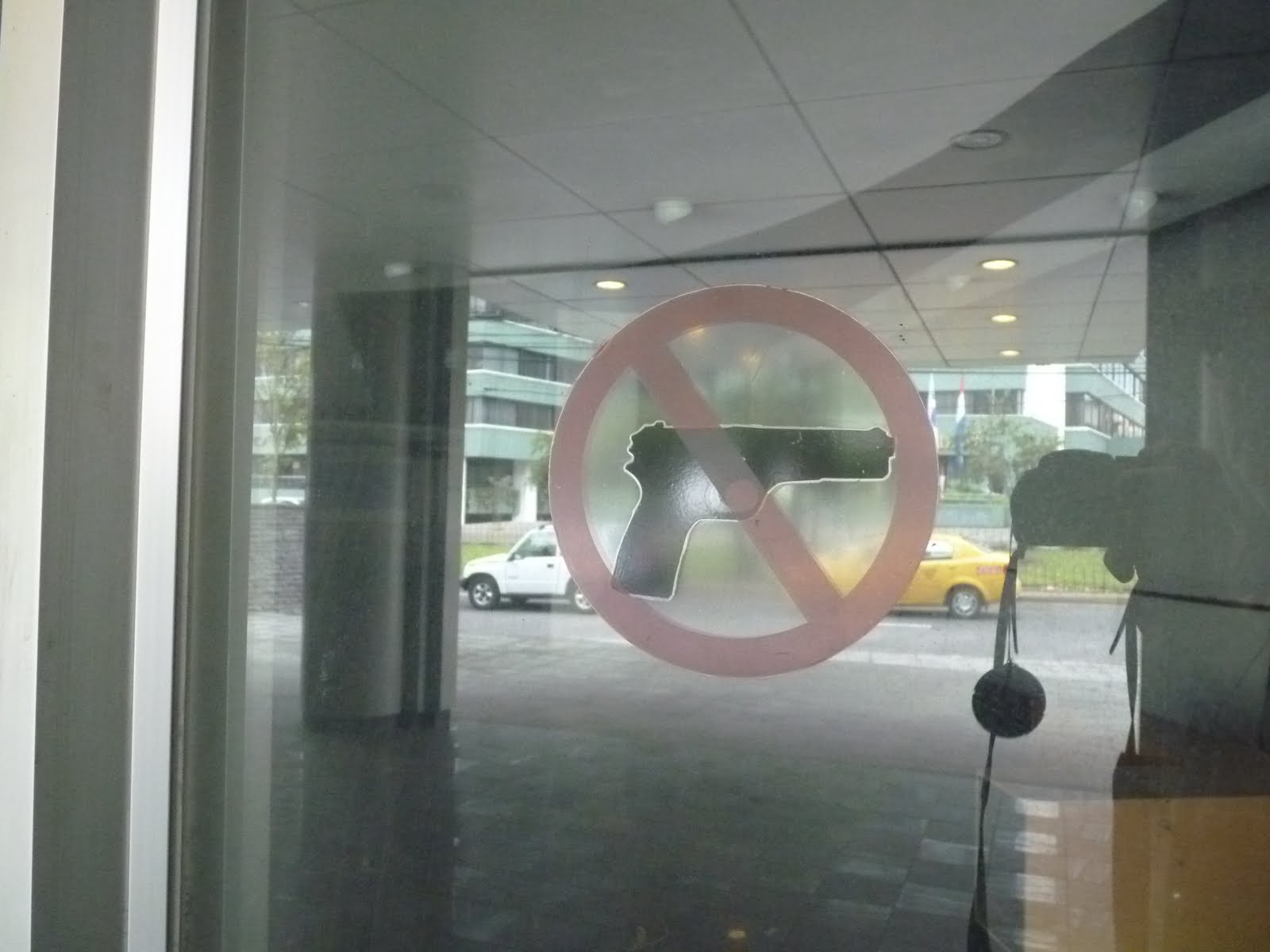
And house alarms. And bars on windows, electronic gates everywhere, businesses that are locked all day (you want to buy something, you ring the bell), armed guards everywhere (my favorite is the armed bakery guard with the bulletproof vest...), and if there's no money for security, you can just put up the "no gun" sign and hope for the best...

I'd post more pictures but it takes more than 10 minutes each to upload one photo with my underpowered little netbook.

Bye, bye, Quito!
Next post: Cuzco, Peru, one of the most spectacular cities in the world...


Even though there is supposedly this great influx of cons and shady operators from other countries, when my pocket was picked, it was by a bona fide Ecuadorian.

(T'was at a bus station: a cleaning lady bowled me over and her accomplice the station agent pocketed $20 US. All very local...)